
Deep within the forest, mushrooms quietly push their way through fallen leaves, each one a sign of something far greater below. Underneath each delicate cap lies an underground spiderweb of life connecting trees, nourishing soil, and forming a communal organism that knits entire ecosystems together.
Long overlooked as simple toadstools or feared as poisonous curiosities, fungi are finally gaining recognition for what they truly are: nature’s neurological network. Winding through soil and tree roots, fungi recycle nutrients, support plant life, and even offer healing properties. As these unassuming organisms begin to “pop their tops” in the public consciousness, they spore a call for preservation. It’s time we remember the roles they play not only in our ecosystems, but in our medicines, cultures, and futures.
On the side of a decaying tree trunk in autumn. Clusters of oyster mushrooms bloom like petals from the bark. As fungi digest fallen wood and leaves, they unlock the nutrients trapped inside. This is the key to returning carbon, nitrogen, and phosphorus back to the soil, nourishing the next generation.
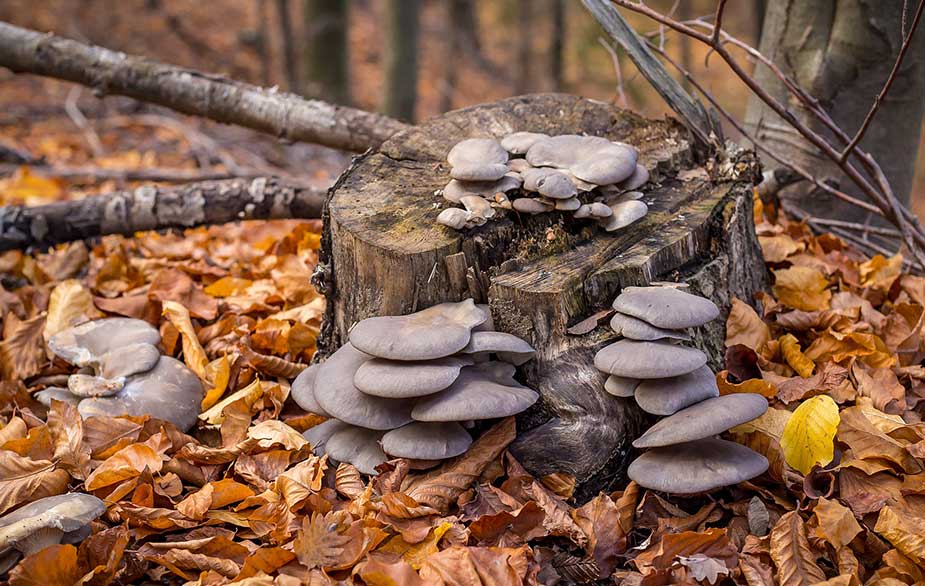
Walk through any woodland and you’re treading on the Earth’s perfect recyclers. Fungi break down not just plant debris but even animal remains. Transforming death into life again through powerful enzymes, that, without them, forests would suffocate beneath their decay, starved of the essential elements needed to grow again.
This process does more than sustain ecosystems, as it plays a crucial role in stabilizing our climate. As fungi break down organic matter, much of the carbon they process becomes locked into the soil. Mycorrhizal fungi, in particular, form symbiotic partnerships with plant roots and are believed to store up to 60% of a forest’s soil carbon. These vast underground networks function like carbon vaults, putting fungi not just as natural recyclers, but as vital allies in the fight against global warming.
Through their silent labor, fungi maintain the forest’s breath and the planet’s balance. But how does it all… connect?
The Wood Wide Web
Beneath that same decaying tree, a sprawling mycelial network unfolds, linking trees and plants in a living internet. Through this network, trees communicate, share nutrients, and even warn each other of dangers. These connections, called mycorrhizae, are mutual partnerships where fungi receive sugars from trees in exchange for helping roots absorb water and minerals far beyond their natural reach.
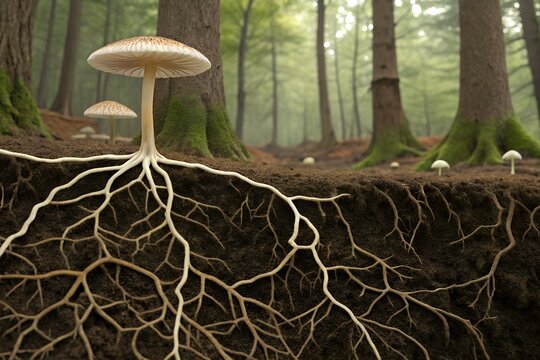
This web of connection isn’t limited to one tree or species, either. A single fungus can link multiple trees of different kinds, creating a forest-wide network that enables resource sharing and communal resilience. For example, when a young sapling is shaded and struggling, surrounding trees may send the sapling extra carbon through the mycelium. Also, if one tree is attacked by insects, it can send distress signals through the network. These signals tell the neighbors to boost their chemical defenses
Scientists have found that these fungal networks transmit electrical impulses much like neural signals in animal brains. Some researchers suggest this may indicate a primitive form of communication allowing fungi and trees to sense and respond to their environment together. This opens the door to a whole new conversation. Even branching into how fungi aren’t plants OR animals. But long before modern science began studying fungi, traditional cultures across the world knew of their healing powers. From Taoist monks to Indigenous North Americans, mushrooms have long been respected for their medicinal and spiritual significance.
Here are just a few:
🍄 Medicinal Mushrooms: Nature’s Pharmacy
Reishi (Ganoderma lucidum) – The Mushroom of Immortality
- Traditional Use: Revered in Traditional Chinese Medicine for over 2,000 years.
- Primary Benefits:
- Supports immune modulation through beta-glucans and triterpenoids
- Reduces systemic inflammation
- Enhances sleep and reduces anxiety (adaptogenic effects)
- Supports immune modulation through beta-glucans and triterpenoids
Lion’s Mane (Hericium erinaceus) – The Brain Booster
- Appearance: Icicle-like, cascading spines—striking and unmistakable.
- Primary Benefits:
- Stimulates Nerve Growth Factor (NGF), promoting brain regeneration
- Enhances memory, focus, and mental clarity
- May support mood regulation and combat mild depression or anxiety
- Stimulates Nerve Growth Factor (NGF), promoting brain regeneration
Turkey Tail (Trametes versicolor) – The Immune Ally
- Appearance: Multicolored, fan-shaped bands resembling a turkey’s tail.
- Primary Benefits:
- Strengthens immune system response
- Supports gut health by acting as a prebiotic for beneficial gut flora
- May boost energy and vitality during chronic illness
- Strengthens immune system response
- Scientific Highlights:
- PSK (Polysaccharide K) and PSP (Polysaccharide-Peptide) are studied for their anti-cancer properties
- PSK is an approved adjunct cancer therapy in Japan, particularly for gastric and colorectal cancers
- PSK (Polysaccharide K) and PSP (Polysaccharide-Peptide) are studied for their anti-cancer properties
Shiitake (Lentinula edodes) – The Culinary Cure
- Dual Role: Both a flavorful food and powerful medicinal ally.
- Primary Benefits:
- Supports immune health and white blood cell activity
- May reduce cholesterol levels and support cardiovascular wellness
- Possesses antiviral and antibacterial properties
- Supports immune health and white blood cell activity
Each of these mushrooms bridges the ancient and the modern, reminding us that fungi have always played a role in healing. Additionally, the most astonishing fungal discoveries have come not from healing us or forests, but from places of utter catastrophe.
In 2017, researchers discovered strains like Aspergillus tubingensis that can degrade polyurethane, a tough plastic found in insulation, electronics, and footwear. These fungi release enzymes that break plastic polymers into smaller molecules, offering a glimpse into a biological solution for plastic waste.
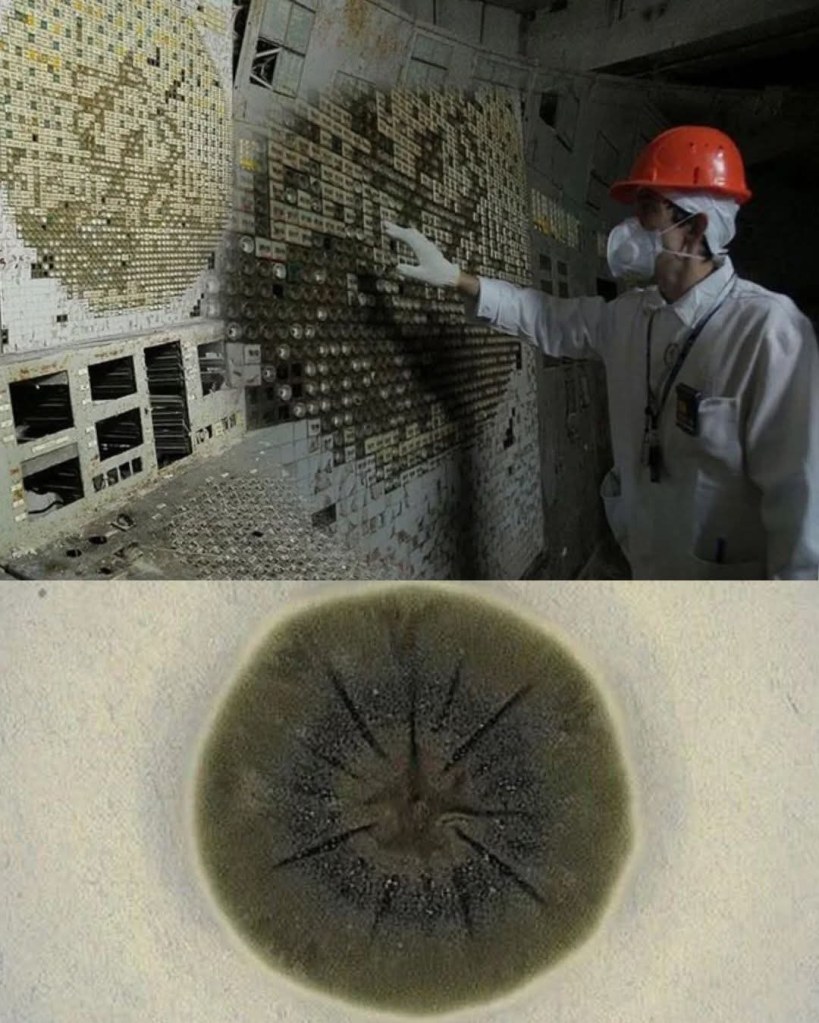
And in one of the most contaminated places on Earth, the Chernobyl Exclusion Zone, fungi have found a way to thrive. Species like Cladosporium sphaerospermum not only survive radiation but feed on it through a process called radiosynthesis. Like plants turning sunlight into energy, these fungi use the pigment melanin to convert gamma radiation into chemical energy.
These incredible discoveries highlight fungi’s potential to face some of humanity’s biggest challenges. In the face of nuclear disaster and mounting pollution, fungi aren’t just surviving.
They’re adapting, innovating, and quietly restoring what has been lost.
As scientists explore these breakthroughs, one thing is clear: fungi may hold keys not only to healing our bodies but also to healing our planet.
Despite all they do, fungal habitats are increasingly under threat.
Deforestation, synthetic chemicals, and industrial agriculture damage and destroy the delicate mycelial webs that support ecosystems. When forests are logged and soils stripped bare, these underground connections are severed, weakening not just fungi, but the entire forest system that depends on them.
Fungal biodiversity is vast but underexplored. Of the estimated 2 to 5 million fungal species on Earth, only a small fraction have been named or studied. With each loss of habitat, we may be losing crucial discoveries right under our feet.
Fungi teach us that life is not linear, but interconnected. They remind us that decay is not the end but a transformation. In the mycelial web, we see a vision of cooperation, renewal, and resilience.
Preservation begins with awareness. If you stumble across mushrooms on a forest path, let them be. Leave the log where it rests. If you grow food, consider practices that feed the soil instead of stripping it. If you forage, do so mindfully and respectfully, taking only what you need and never from endangered species.
Support farmers and companies that nurture fungal health and those who say no to pesticides and yes to living soil. Add a variety of mushrooms to your plate. And if you find fungi fascinating, dive deeper. Learn their names. Learn their stories. Drop a comment, and maybe we’ll touch further on these subjects again.
Because beneath our feet is more than dirt. It is memory, intelligence, medicine, and possibility.
References:
1. Minnesota Mycological Society. Sustainability. Minnesota Mycological Society
4. National Geographic Society. Decomposers. National Geographic Education
5. Smithsonian Magazine. Do trees talk to each other?
6. UN Environment Programme. (2018). Fungi research lifts lid on shy organisms that break down plastic

 The Red Fox Gazette
You must be logged in to post a comment.